
The Johari Window — Shrinking Your Blind Spot
You've met the person whose meetings always end on a slightly flat note — and who has no idea why. Everyone in the room can see it. They can't. This "version of you that you can't see" isn't a rare condition reserved for difficult people. Everyone has one. And the cleanest tool for understanding it is the Johari Window.
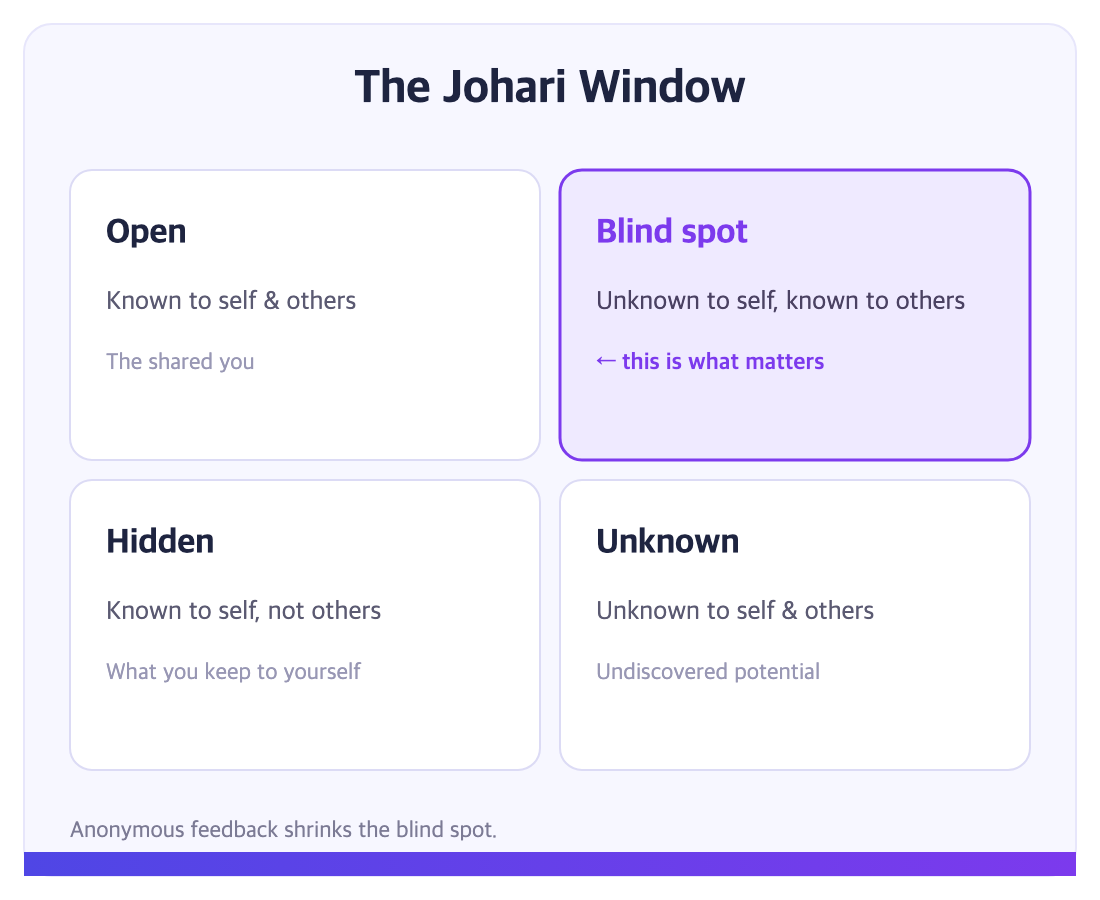
The Johari Window's four panes
In 1955, psychologists Joseph Luft and Harry Ingham built a simple model of self-awareness called the Johari Window. It splits you across two axes: "do you know it about yourself?" and "do others know it about you?" That gives four panes.
- Open — known to you and to others. (That you talk fast.)
- Hidden — known to you, kept from others. (The worry you don't voice.)
- Blind spot — known to others, invisible to you. This is the troublemaker.
- Unknown — not yet known to anyone. (Potential that only shows up in untried situations.)
The problem is the blind spot
Of the four panes, the blind spot is the one that does the quiet damage — for a structural reason. By definition, it's the part of you that others can see but you can't. And you can't fix what you can't see.
This is why capable people sometimes stall. In a career, someone can have all the skills and still plateau, genuinely puzzled about why. Their colleagues, meanwhile, can name the pattern instantly — a defensive tone, a habit of not passing credit along. The one person who can't see it is the one it belongs to.
In relationships, the same thing happens. If you keep hitting the "I'm being considerate, so why do people keep misreading me?" loop, there's likely a sizable blind spot between the self you intend and the self other people actually experience.
Organizational psychologist Tasha Eurich has found that while about 95% of people believe they're self-aware, only 10–15% actually demonstrate it. Most of us are badly underestimating the size of our own blind spot.
How to shrink it
In Johari Window terms, the move is straightforward: take in feedback and move material out of the blind spot and into the open pane. Once you also know the thing others already knew, it stops being blind.
The catch is that the feedback rarely arrives. The closer someone is to you — or the larger the power gap between you — the more they soften what they actually think. Few people will risk an awkward relationship to tell you the truth. So what reaches your ears is a loop of "it was fine" and "you did great" — kind, and completely uninformative.
That's exactly why anonymous feedback is so powerful. When no name is attached to the answer, the fear of breaking a relationship disappears. With no social cost to being direct, people simply are. Anonymity is what lets the real thing come through.

Add one more ingredient: collect from several people. A single comment might just be one person's mood. But when several people independently say the same thing, that's not mood — it's a pattern. And the pattern is the part most likely to be your actual blind spot.
Start small
Shrinking a blind spot doesn't require a formal process. It can start with one specific question to one person you trust: "What's the most frustrating moment for you when we work together?"
If asking face-to-face feels too loaded, you can use mirroo.me: create a question about yourself and share it as an anonymous link. The people you send it to leave honest impressions with no identity attached, and the AI surfaces the common patterns rather than individual replies. You see the overall shape of how you come across — not who said what.
The first moment of light hitting a pane you couldn't see can be uncomfortable. But you can only fix what you can finally see. That's the most practical lesson the Johari Window has to offer.
Curious how you come across on this? Ask anonymously
Sign up