
One Voice vs. Many Patterns — Reading Honest Feedback
You know the feeling of chewing on one offhand comment for days. "You can come across a little cold." Suddenly you're wondering whether you're a cold person. But what if that one person was just having a tense day? What if there was something unresolved between you two? A single piece of feedback can be the truth — or it can be one person's mood in one moment. The trouble is that from the inside, the two are almost impossible to tell apart.
The trap of a single data point
One comment carries less information than it feels like it does. Bundled into it are the speaker's mood that day, their personal history with you, their individual values, and the odd misunderstanding — all tangled together. Signal and noise arrive as a single lump.
So when you over-weight one voice, you make one of two mistakes. Either you mistake the noise for signal and start "fixing" something that was never broken. Or you wave off real signal as "what would they know." With a sample size of one, both are hard to avoid.
When several people say it, it's a pattern
The fix is almost embarrassingly simple: increase the sample size.
If one person calls you cold, that could be their mood. But if five people who don't know each other each say, on their own, "you were hard to approach at first" — that's no longer anyone's mood. It's a pattern. When people who couldn't have coordinated all point at the same spot, there's almost certainly something really there.
This is the same reason a poll surveys a thousand people instead of one. Individual quirks cancel out as the numbers grow, and the genuine tendency is what's left standing. One person's take is an opinion. Many people converging is data.
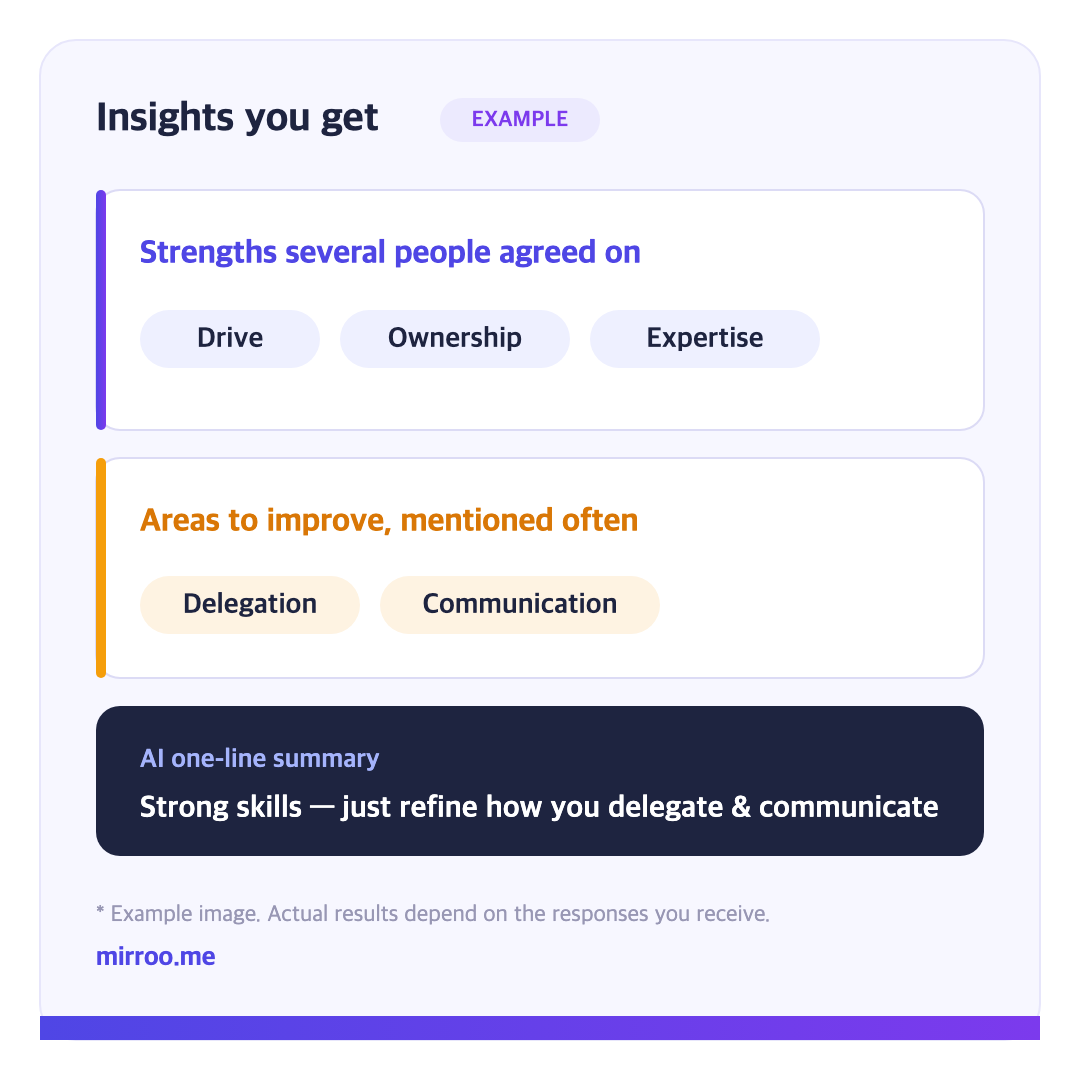
This lens also changes how it feels to receive feedback. You no longer have to be wounded by a single comment. If your default reaction is "that's one opinion; whether it's a pattern is still an open question," you can stay emotionally steady without tuning out the real signal.
Honesty comes from anonymity
There's one more condition. Even if you ask many people, the answers have to be honest for the pattern to mean anything. If all five politely said "you were great," then five times the data still tells you nothing.
And people rarely get honest to your face — because honesty carries a relationship cost. Say what you really think, the mood turns awkward, the other person is hurt, and the fallout comes back to you. So we instinctively reach for the safe answer. "It was fine." "You did great."
Anonymity removes exactly that cost. When no name is attached to the answer, there's nothing to lose by being straight. No fear of being judged, no risk of damaging a relationship. As a result, things surface that would never come out in person. People aren't more honest under anonymity because they're meaner — they're more honest because honesty just got free.
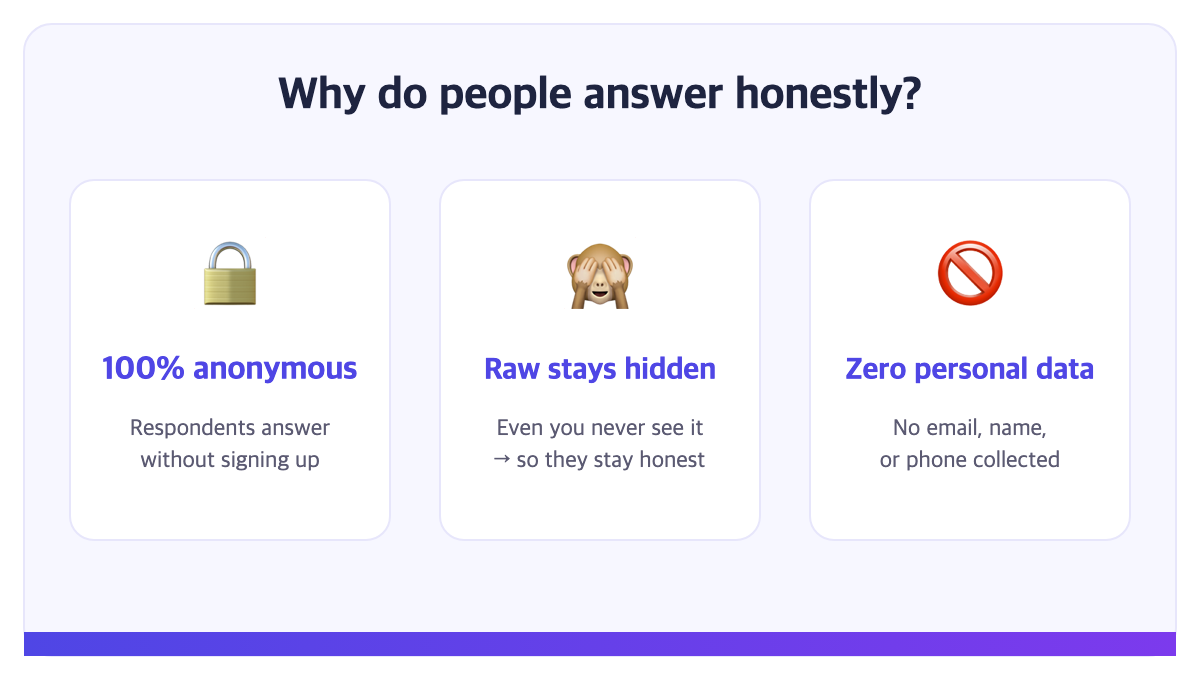
So reliable feedback needs two things: gather it from many people (so a pattern can emerge) and gather it anonymously (so it's honest). Only when those two combine does it stop being one person's opinion and become a trustworthy picture of you.
Collecting the pattern yourself
Gathering this kind of multi-source, anonymous feedback used to be possible only inside a company's formal 360-degree review. Now you can do it on your own.
With mirroo.me, you create a question about yourself and share it as an anonymous link with several people. They leave honest impressions with no pressure, and instead of showing you the raw individual replies, the AI distills the common patterns. You're not reading who said what — you're seeing the outline of yourself that emerges where many people's perspectives overlap.
You don't have to be shaken by one voice. But when several point at the same place, it's worth a serious look.
Curious how you come across on this? Ask anonymously
Sign up