
Good Feedback Starts With Good Questions
Ask the same person two different questions and you'll get wildly different answers. Ask "How am I doing?" and you'll almost always get something safe like "Yeah, you're great." But ask "When I shared my opinion in that last meeting, how did it land? Anything you wish came across more clearly?" and suddenly you get something specific and honest. If your feedback always feels generic and useless, it's probably not because people don't care. It's because the question was hard to answer.
What makes a question good
Questions that pull out useful answers tend to share a few traits. Keep these in mind.
1. Be specific, not vague
"How am I doing?" is too big. People don't know where to start. Easy-to-answer questions are narrow. Pin down just one of these and the answer changes: a time (when), a situation (in what setting), or a behavior (when I did what). "How's my leadership?" is weak. "When I run a meeting, do I guide decisions well, or do I push too fast?" is much better.
2. Mix multiple choice with open-ended
Multiple choice gives you the distribution fast. "7 out of 10 picked 'thorough'" is a signal you can read at a glance. But it won't tell you why people see you that way or what the context was. That's what one or two open-ended questions are for. Distribution from the closed questions, reasons from the open ones. That combination paints the fullest picture.
3. Frame it around comparison or behavior
"What are my strengths?" only invites praise. To surface things you can improve, build in a comparison or a behavior. Try "If you had to pick one thing I should do better, what would it be?" or "Between when we first met and now, how has my impression changed?" Questions like these make it easier for people to be candid, and questions that point at changeable behavior are the ones that actually lead to growth.
4. Guarantee anonymity
Even the best question falls flat if people know their name is attached. The tougher the truth, the more they'll soften it. Honesty you can't normally hear only comes out when answers are anonymous. Designing a good question matters, but so does building a space where people feel safe answering it.
5. Don't ask too much
Pile on twenty questions and people get tired halfway through, start phoning it in, or close the tab entirely. Trimming down to the few things you genuinely want to know is how you get thoughtful answers all the way to the end. Asking for less often collects more.
Building your own
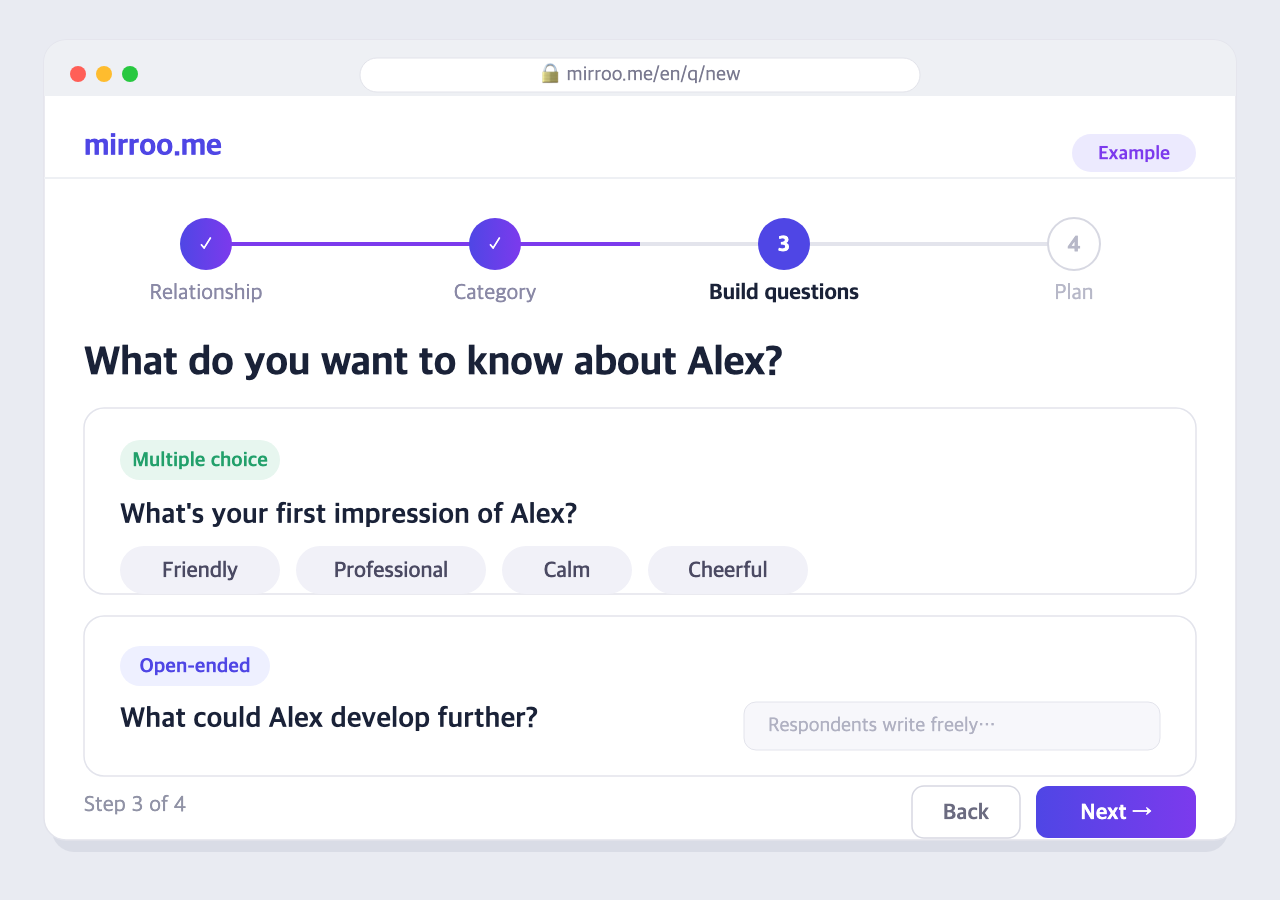
You don't have to memorize all of this. mirroo's question builder suggests proven sets of questions and mixes closed and open formats for you. Below is an example screen (a mockup). Pick a topic and easy-to-answer questions fill in automatically, so you only tweak what you need.
What good questions bring back
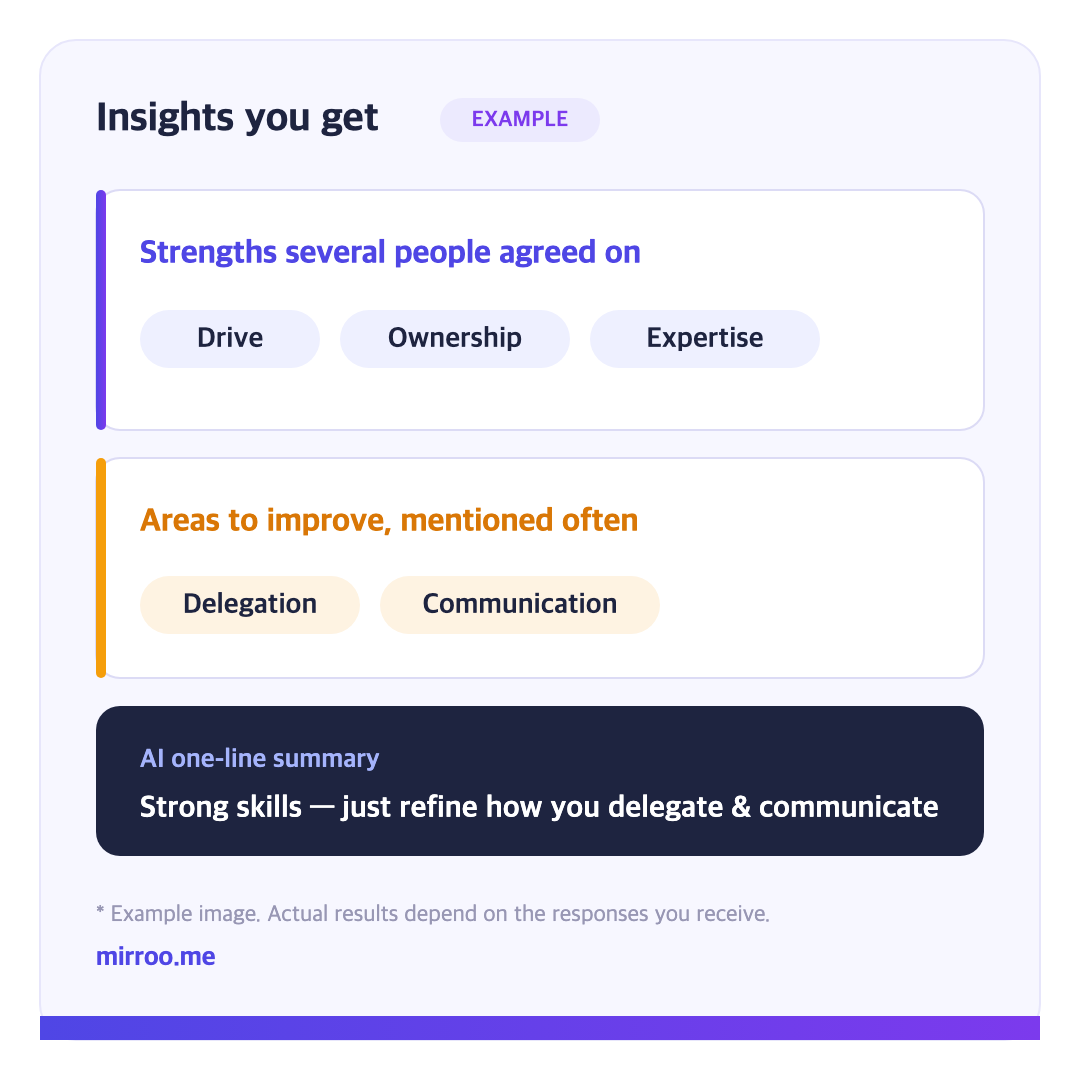
Ask well and the answers change too. Instead of scattered one-liners, you get a pattern: "this is how people generally see me." Below is an example screen of those answers grouped into an insight. The keywords people mentioned over and over, your strengths, and your areas to improve are compressed into a single view, so it's clear what to work on first.
Good feedback isn't luck. It's the result of design. Ask specifically, around behavior, and anonymously, and almost anyone gives you something more honest and more useful. Create a question about yourself at mirroo.me and share the anonymous link. You'll see for yourself what a good question brings back.
Curious how you come across on this? Ask anonymously
Sign up