
Turning Criticism Into Growth — How Not to Get Defensive About Honest Feedback
Praise feels good. But the thing that actually changes us is usually criticism. The trouble is that the moment you face honest feedback, your body reacts before your mind does. Your face gets hot, and your head is already drafting a rebuttal: "Well, the situation was different," or "They just don't know me." That's not a character flaw — it's your brain's self-defense instinct, reading criticism as a threat and rushing to protect you. And yet the people who can set that defense aside, even for a moment, tend to grow faster than everyone else.
Why anonymous, honest feedback is so useful
The closer someone is to you, the more they swallow what they really want to say. Afraid of straining the relationship or hurting your feelings, they settle for something safe and vague. So the very thing you most need to hear often never gets said. Anonymity removes that wall. When no one can be identified, people finally share the honest thoughts they'd normally keep to themselves.
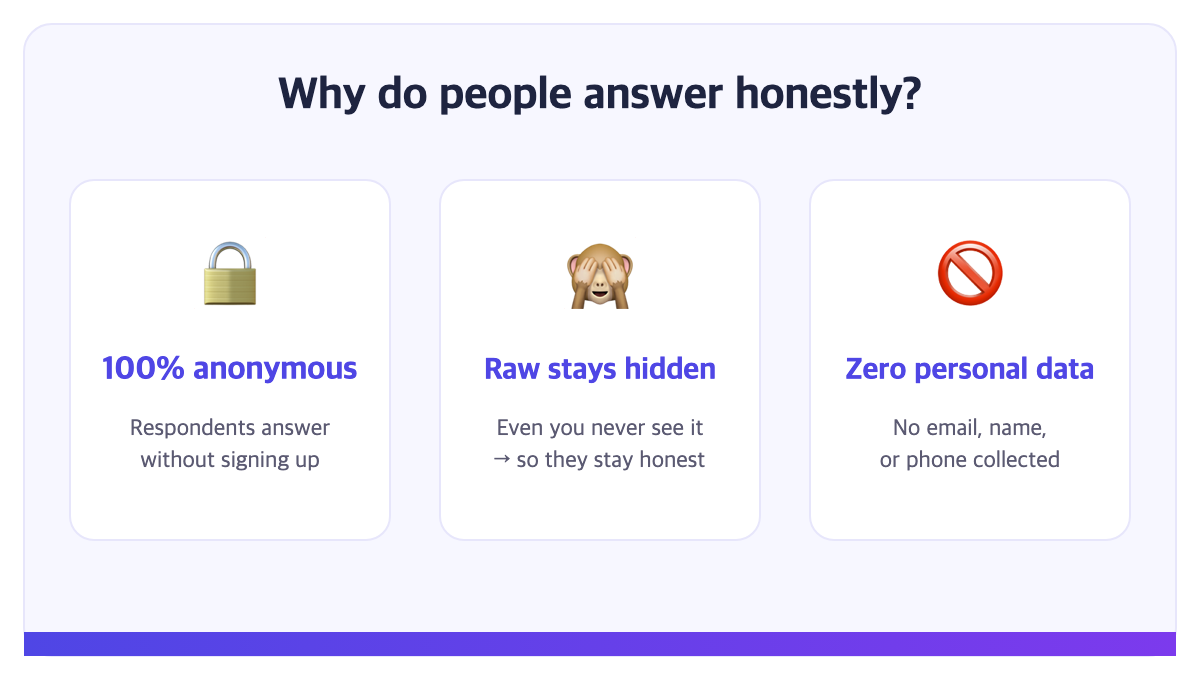
The screen above is an example. Anonymous feedback can sting more than feedback with a name attached, because it arrives raw, without a cushion. But that's exactly why it's valuable. The more it stings, the more honest it is — and the more honest it is, the more useful it is for growth.
Five ways to receive it without getting defensive
1. Don't react instantly — sleep on it
The moment right after you read feedback is when your emotions run hottest, and any judgment you make then is mostly just defense. Instead of responding immediately, let it sit for a day. Read it again the next morning and the sentence that felt like an attack yesterday often reads like plain information today.
2. Look for patterns, not single voices
You don't need to lie awake replaying one person's sharp remark. What actually matters is what several people point to in common. Something one out of ten people said might just be a matter of taste — but if seven people said the same thing, that's a signal. Focus on the recurring pattern, not the individual comment.
3. Treat it as data, not a personal attack
If you read feedback as "they say that because they don't like me," you're left with nothing. Instead, put some distance between you and it: "This is one data point about me." When you treat feedback as information rather than emotion, you can finally pull something usable out of it.
4. Pick only one or two things to change
Try to fix every single criticism and you'll end up exhausted and changing nothing. Choose just one or two things to actually work on this time. Changing something small but for real beats half-heartedly poking at ten things at once.
5. Say thank you
Honest feedback takes courage on the other person's part, too. Instead of defending or explaining yourself, saying "thanks for telling me" makes it far more likely you'll hear the truth again next time. Gratitude is the cheapest investment there is in getting better feedback.
How to read the feedback you get
When honest answers pile up, they stop being scattered one-off remarks and settle into a single picture. The repeated keywords, the strengths and the areas to improve, are compressed onto one page — so you can look at the pattern calmly instead of getting rattled by any single line.

This screen is an example too. Instead of getting wounded by each individual sentence, once you see the bigger picture — "here's how people generally see me" — it becomes far clearer what to change first.
Getting defensive in the face of criticism is completely natural. But if you can loosen that defense just a little, you get to see the version of yourself that others notice and you can't. Create a question about yourself at mirroo.me and send it out as an anonymous link. The answers that sting but stay honest tend to bring more growth than you'd expect.
Curious how you come across on this? Ask anonymously
Sign up